



Asiana Airlines
 South Korea
South Korea's largest low-cost airline
South KoreaCountry
Guide reviewed
Find the lowest fares and compare them with other airlines in one search.
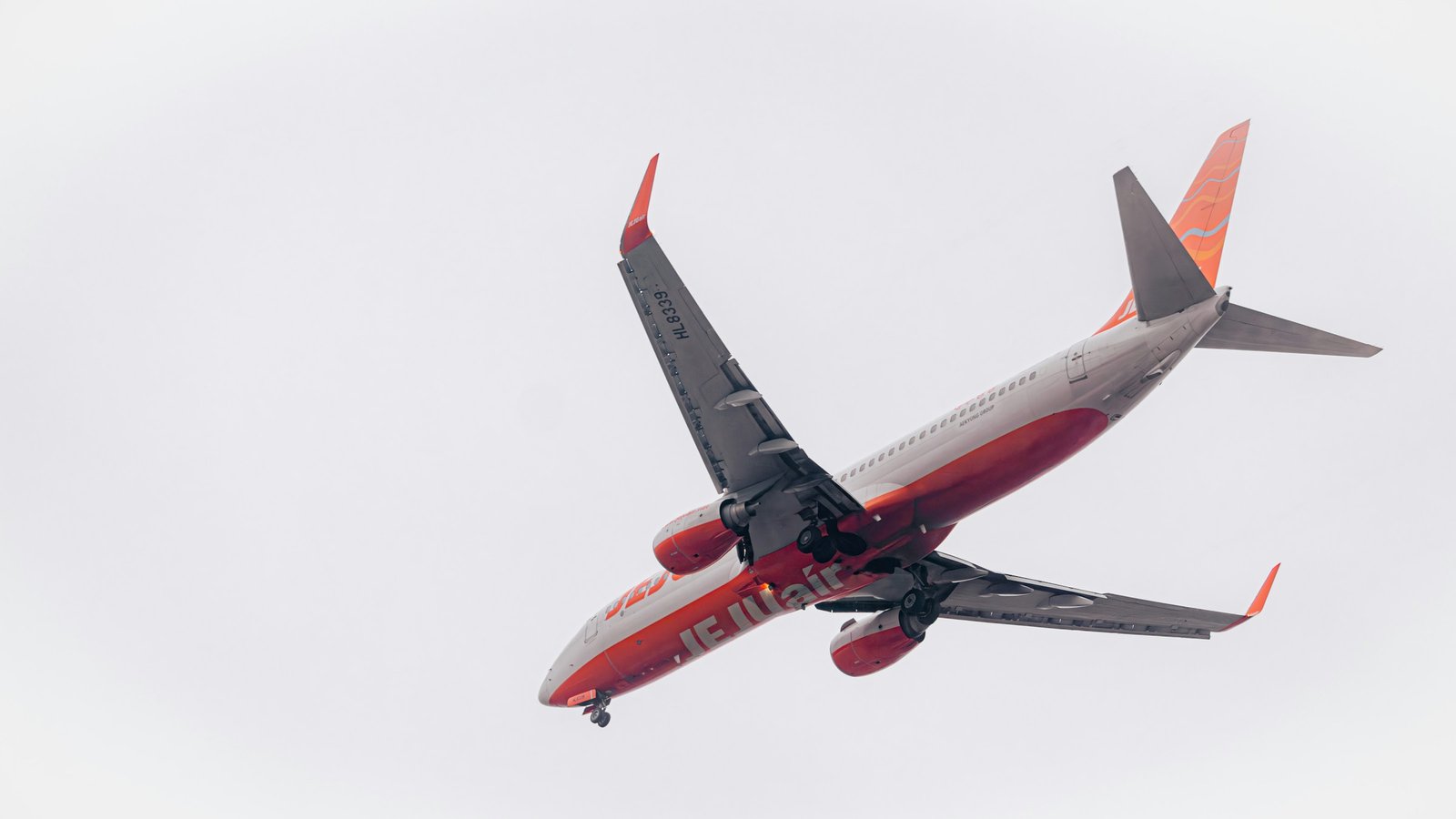
Jeju Air is South Korea’s largest low-cost airline, flying Boeing 737s from Seoul and Busan to Japan, China, Southeast Asia, Guam and Saipan. Its fares are FLY, FLYBAG (15 kg checked bag) and BIZ LITE, and Korean rules have banned using power banks on board since January 2026. This guide covers fares, baggage, power bank rules, safety after the Muan accident and how Jeju Air compares with Korean Air and Eastar Jet.
Jeju Air was founded in 2005 and is South Korea’s largest low-cost airline. It flies Boeing 737s from Seoul Incheon, Gimpo, Busan and other Korean cities to Japan, China, Southeast Asia, Guam and Saipan.

Korean airlines, including Jeju Air, apply strict rules on top of the ICAO standard, and since 26 January 2026 power banks may not be used on board:
On 29 December 2024, Jeju Air flight 2216, a Boeing 737-800, crashed at Muan airport, killing 179 people. As of August 2026 the final accident report had not been published. Korea’s transport ministry admitted in January 2026 that the concrete localizer structure at the end of the Muan runway breached safety standards, and all of Korea’s 737-800s were inspected after the crash.
Online check-in opens on the website and app before departure. Allow two hours for international flights from Incheon.

Low-cost and full-service choices from Korea.
| Jeju Air | Korean Air | Eastar Jet | |
|---|---|---|---|
| Type | Low-cost | Full-service | Low-cost |
| Main base | Incheon and Gimpo | Incheon | Gimpo and Incheon |
| Cabin bag | Up to 10 kg | 10 kg (Economy) | Depends on fare |
| Best for | Japan and Southeast Asia | Long-haul and premium travel | Short trips from Seoul |
See our Korean Air guide and Eastar Jet guide to compare.
From Incheon, the AREX train reaches Seoul Station in about 45 minutes; Gimpo is linked to central Seoul by subway lines 5 and 9.
You can also book an airport transfer in advance at a fixed price.
Jeju Air offers a large Korean low-cost network with good value fares. Pick the fare that matches your luggage, and remember Korea’s in-flight power bank ban.
For more options, see our airline guides and the FlightSelects travel blog.
Facts checked in October 2026 against Wego’s August 2026 safety summary and a Jeju Air fare summary. Rules change, so check the official Jeju Air website before you travel.
Jeju Air is not a member of a major global airline alliance. Its fares are sold mainly on its own website and app.
Jeju Air works with some partner airlines on selected routes, but most of its flights are sold as point-to-point low-cost tickets.
Jeju Air flies from Seoul Incheon (ICN), Seoul Gimpo (GMP), Busan (PUS) and Jeju (CJU), its home base.
Jeju Air's busiest routes link Seoul Gimpo with Jeju, and Seoul Incheon with Tokyo, Osaka, Fukuoka, Bangkok, Da Nang and Cebu. Choose a route to see recent schedules and fares.
Fares are the lowest recently found by our partners and can change quickly. Select a fare to check live prices and availability.
Jeju Air sells three fares: FLY, the cheapest, with cabin baggage only; FLYBAG, which adds a checked bag; and BIZ LITE, with the biggest allowance and more flexibility. The cheapest fares have the highest change and cancellation fees.
When you change, you pay any fare difference plus any fee for your fare type. Fees usually rise closer to departure.
Seat selection, extra-legroom seats, meals and extra baggage are available as paid extras, which are cheaper when bought online before you fly.
Jeju Air also offers a few premium seats with more space on some aircraft.
Every Jeju Air fare includes cabin baggage of up to 10 kg. FLY includes no checked bag; FLYBAG includes one 15 kg bag on most routes (23 kg to Guam and Saipan); and BIZ LITE includes one 30 kg bag (two 23 kg bags to Guam and Saipan).
Extra baggage costs much less when bought online before departure than at the airport, and no single bag may weigh more than 32 kg.
Refresh Points is Jeju Air's free loyalty programme. Members earn points on Jeju Air flights as a share of the fare paid rather than by distance, and can use them towards tickets and extras.
The airline's two-character IATA code is 7C. It appears in flight numbers (for example 7C 101), on tickets and on airport departure boards. Its three-letter ICAO code is JJA, which air traffic control and flight-tracking services use to identify the airline.
It is not a member of a global airline alliance, although it may still have codeshare or interline agreements with individual airlines.
The airline is headquartered in Jeju City, South Korea.
The airline was founded in 2005.
Its main hubs and focus cities are: Jeju (CJU) – Home Base; Seoul (ICN) – Main Hub.
Jeju Air flies from Seoul Incheon, Seoul Gimpo, Busan and Jeju, with Gimpo–Jeju among its busiest routes.
Not on FLY fares. FLYBAG includes one 15 kg bag on most routes and BIZ LITE one 30 kg bag. Every fare includes up to 10 kg of cabin baggage.
FLY (cabin baggage only), FLYBAG (adds a checked bag) and BIZ LITE (the biggest allowance and more flexibility).
Refresh Points are earned as a share of the fare you pay and can be used towards Jeju Air tickets and extras.
South Korea
South Korea

South Korea
South Korea

South Korea
 Mongolia
Jeju Air, its logo and trademarks are the property of Jeju Air Co., Ltd. and are used for identification and informational purposes only. FlightSelects is not affiliated with or endorsed by Jeju Air unless expressly stated. FlightSelects may earn a commission when you book through partner links, at no extra cost to you.