

Aerolíneas Argentinas
 Argentina
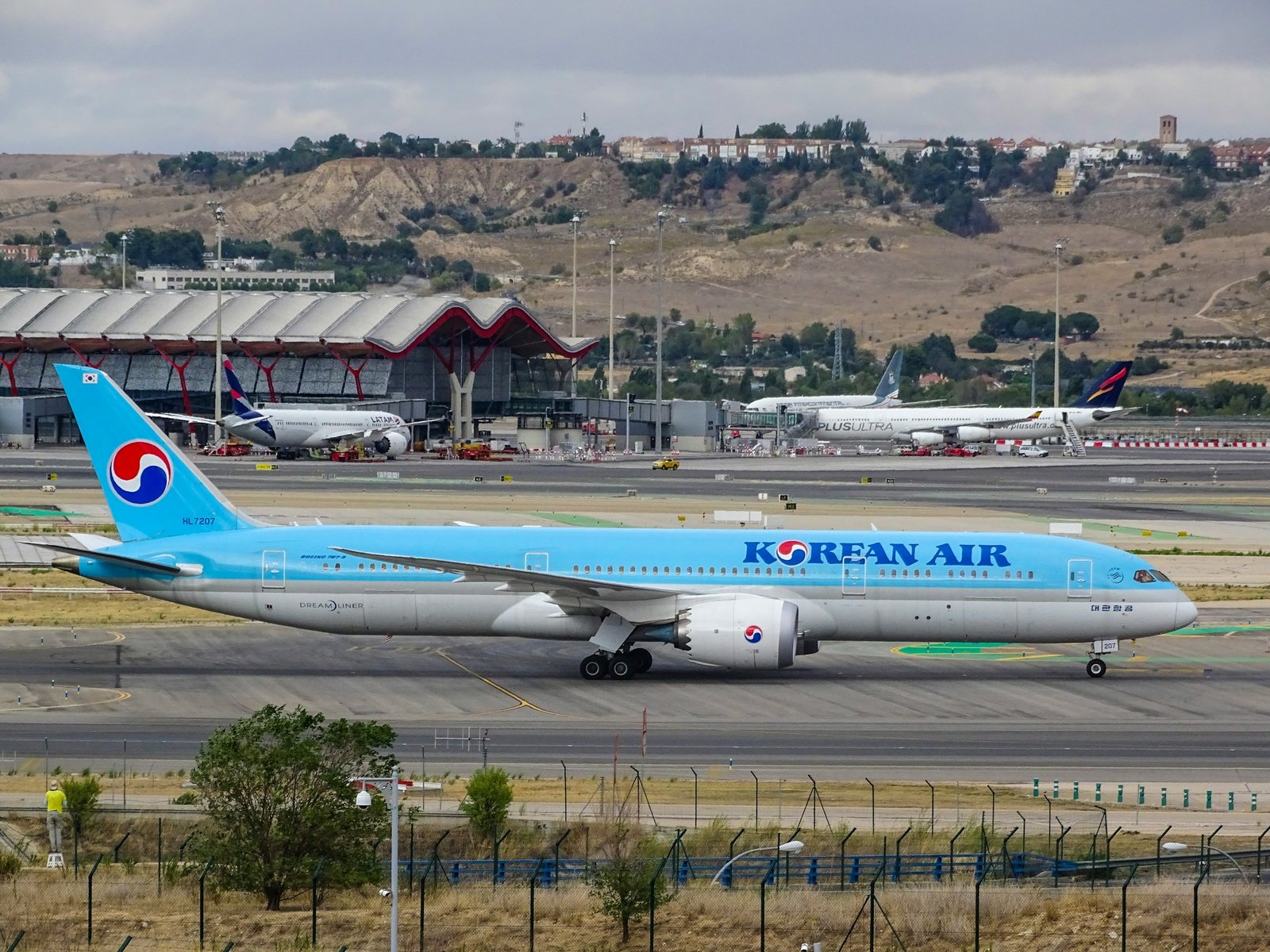
South Korea's flag carrier, flying from Seoul Incheon
 South KoreaCountry
Guide reviewed
Find the lowest fares and compare them with other airlines in one search.
Korean Air is South Korea’s flag carrier and a SkyTeam founder, flying from Seoul Incheon to more than 100 cities in Asia, the Americas, Europe, Oceania and the Middle East. Asiana Airlines fully merges into Korean Air on 17 December 2026, and since January 2026 power banks cannot be used on Korean airlines. This guide covers the merger dates, baggage, the power bank ban, Incheon tips, SKYPASS and how Korean Air compares with JAL and ANA.
Korean Air took its current name in 1969, when the Hanjin Group took over the state-owned Korean National Airlines. It is based in Seoul, was a founding member of SkyTeam in 2000 and is one of the world’s largest cargo airlines.

Korean Air took control of Asiana Airlines in December 2024. The full merger completes in December 2026, when the Asiana brand disappears.
| Date | What happens |
|---|---|
| 15 October 2026 | Last day to earn Star Alliance miles (such as Aeroplan) on Asiana flights |
| 16 December 2026 | Asiana leaves Star Alliance at 23:59 Korea time |
| 17 December 2026 | Asiana fully merges into Korean Air |
If you hold an Asiana ticket for travel after 17 December, it will be operated by Korean Air. Check your booking and terminal before you fly.
Since 26 January 2026, Korean Air, Asiana, Jin Air, Air Busan and Air Seoul ban power bank use on all their flights:
Online check-in is available on the website and app. Korean Air uses Incheon Terminal 2, which also handles other SkyTeam airlines. As Asiana flights move across, check your terminal on your booking.
Allow at least two and a half hours for international departures, more during Chuseok and Lunar New Year.
Bassinets can be requested on long-haul flights, and infants under two travel on an adult’s lap. Request wheelchairs and other special assistance in advance.
All three are premium North Asian airlines with generous Economy carry-on allowances.
| Korean Air | Japan Airlines | ANA | |
|---|---|---|---|
| Hub | Seoul Incheon | Tokyo | Tokyo |
| Alliance | SkyTeam | oneworld | Star Alliance |
| Economy carry-on | 10 kg | 10 kg | 10 kg |
| Economy checked bags | 1 × 23 kg (2 to the Americas) | Usually 2 × 23 kg | 0–2 × 23 kg by fare |
| Power banks | No use on board, not in bins | 2, no charging on board | 2, no charging on board |
| Low-cost sister | Jin Air | ZIPAIR | Peach |
See our Japan Airlines guide and ANA guide to compare.
Incheon International Airport is linked to Seoul by the AREX express train and airport limousine buses, and taxis are available.
You can also book an airport transfer in advance at a fixed price.
Yes. Korean Air offers excellent service, a 10 kg carry-on in Economy, comfortable Prestige seats and SkyTeam connections. After the Asiana merger it will run one of Asia’s largest networks.
For more options, see our Asiana Airlines guide, our airline guides and the FlightSelects travel blog.
Facts checked in October 2026 against International Airport Review on the power bank ban and Prince of Travel on the merger timeline. Rules change, so check the official Korean Air website before you travel.
Korean Air is a founding member of SkyTeam (2000). You can connect in Seoul onto partners such as Delta, Air France, KLM and Vietnam Airlines on one ticket and earn SKYPASS miles across the alliance.
Learn more about SkyTeamKorean Air runs a trans-Pacific joint venture with Delta, coordinating schedules and fares between the US and Asia. Asiana Airlines, now owned by Korean Air, is being merged into the airline.
Seoul Incheon International Airport (ICN) is Korean Air's main hub for international flights. Seoul Gimpo (GMP) handles most domestic flights and some short international routes.
Korean Air's busiest routes link Seoul with Tokyo, Osaka and Bangkok, Gimpo with Jeju, and Incheon with Los Angeles, New York and Paris. Choose a route to see recent schedules and fares.
Fares are the lowest recently found by our partners and can change quickly. Select a fare to check live prices and availability.
Korean Air sells several Economy fare types, from discounted fares with higher fees to standard and flexible fares, plus Prestige Class (business) and First Class. Change and refund fees depend on your fare and on when you change.
When you change, you pay any difference in fare plus any fee for your fare type. For flights to or from the USA, the US 24-hour cancellation rule applies.
You can choose a seat when booking or at check-in, and buy Economy seats with extra legroom on many flights. Prestige Class has lie-flat seats on long-haul aircraft, and First Class has private suites on selected routes.
Korean Air's lounges at Incheon are open to Prestige and First Class passengers and to SKYPASS elite members.
In Economy you can bring one carry-on bag of up to 10 kg plus one personal item. Prestige and First Class passengers can bring two carry-on bags with a combined weight of up to 18 kg.
On most international routes, Economy includes one 23 kg checked bag, rising to two 23 kg bags on flights to and from the Americas. Prestige Class includes two 32 kg bags and First Class three 32 kg bags. Domestic flights have their own allowance.
SKYPASS is Korean Air's free loyalty programme. You earn miles on Korean Air and SkyTeam flights and with partners, and redeem them for award flights and upgrades. Asiana Club members' miles are being converted to SKYPASS as part of the merger.
Frequent flyers can reach Morning Calm, Morning Calm Premium and Million Miler status, recognised as SkyTeam Elite and Elite Plus.
The airline's two-character IATA code is KE. It appears in flight numbers (for example KE 101), on tickets and on airport departure boards. Its three-letter ICAO code is KAL, which air traffic control and flight-tracking services use to identify the airline.
It is a member of SkyTeam. Alliance membership usually means easier connections, shared lounge access for eligible passengers and the option to earn and redeem miles across partner airlines.
The airline is headquartered in Seoul, South Korea.
The airline was founded in 1969.
Its main hubs and focus cities are: Seoul (ICN) – Main Hub.
The frequent flyer programme is called SKYPASS. Members earn points or miles on eligible flights and can redeem them for award tickets, upgrades and other benefits.
In Economy, one carry-on bag of up to 10 kg plus a personal item. Prestige and First Class allow two bags with a combined weight of up to 18 kg.
One 23 kg bag on most international routes, and two 23 kg bags on flights to and from the Americas.
Yes. Korean Air took control of Asiana in December 2024, and Asiana is due to merge fully into Korean Air on 17 December 2026.
Argentina

 Mexico

 Spain
 France
 Taiwan

 China

South Korea
South Korea
South Korea

South Korea

South Korea
 Mongolia
Korean Air, its logo and trademarks are the property of Korean Air Lines Co., Ltd. and are used for identification and informational purposes only. FlightSelects is not affiliated with or endorsed by Korean Air unless expressly stated. FlightSelects may earn a commission when you book through partner links, at no extra cost to you.